New here? Get a 7-day free trial.Full access to every number and matchup. Then $15/mo or $110/yr, cancel anytime.Start free trial →

Before I bet any NBA player prop, I want to answer three questions: how many minutes and shots is he likely to get, how does this defense handle the way he scores, and how often does he actually clear this line?
Here is the step-by-step process I use to answer them, and where to find each piece on Propaholics. At the end, I walk through a real example: AJ Green over 6.5 points against the Cavaliers. No single stat makes a pick. The best props are the ones where every step points the same way.
Like these picks? Get the whole board.
These picks come straight off the Propaholics board. Unlock our model's odds, edge, and verdict on every NBA player prop, plus shooting, rebound, and assist matchups, projections, and lineups.
Start your free 7-day trialStart by asking how this game is going to go. The total (over/under) tells you how many points the books expect. A higher total, around 230 or more, means a faster game with more possessions, and more shots, rebounds, and assists to go around. A low total means less volume for everyone.
Bonus tip: work out each team's implied total. Divide the game total by 2, then subtract half the spread for the favorite and add it for the underdog. With a 235.5 total and a team favored by 9.5, that team is implied for about 122.5 points and their opponent for about 113. Now you know which offense the books expect to score more. The total and spread sit at the top of every player page.
A spread of 12 points or more means the game could be over early. When that happens, starters often sit the fourth quarter and lose six to ten minutes, which is bad news for their overs.
It cuts the other way for bench players. Someone has to play those minutes, usually the backup guards and wings. So a big spread is a reason to be careful with a starter's over, and can be a reason to like a bench player's over.
To see how a player has done in blowouts, open Filters on his player page and set Final margin to 12 or more.
A back-to-back means games on two nights in a row. On the second night, legs are tired, coaches trim minutes, and some stars sit out completely. A player with a few days off should be fresh and play his normal role.
On the player page, open Filters and use the Rest row to see only back-to-backs or only rested games. Whichever one matches tonight is marked (current).
Injuries move minutes and shots around, and they do not always go to the same player. When a team's best scorer is out, the backup at his position usually gets the minutes, but the shots often go to the next-best scorer. Ask both: who gets the minutes, and who gets the shots?
Check the NBA lineups page for tonight's starting fives and who is out or questionable. On the player page, the with/without teammate filter shows how he has played when a specific teammate sat. Also check the other side. A defense missing its best perimeter defender or rim protector is easier to attack.
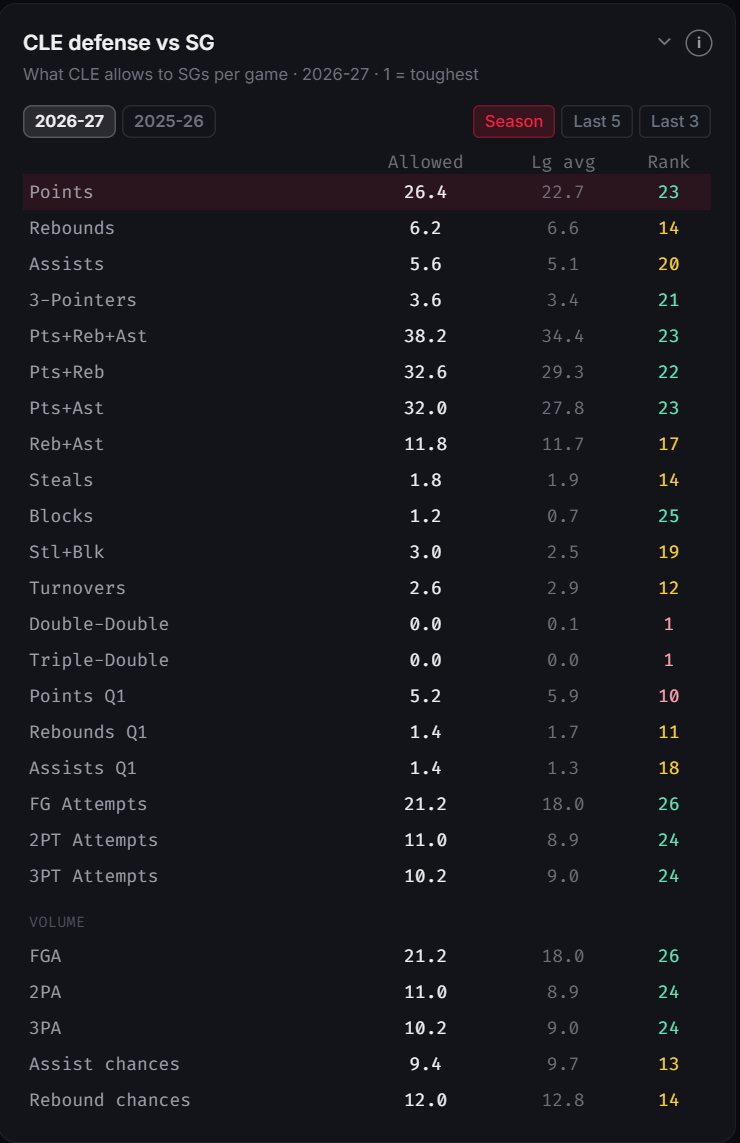
Open the free defense vs position rankings and see what this defense allows to the player's position: PG, SG, SF, PF, or C. A defense ranked near the bottom against shooting guards is a green light to look at shooting guard overs. A defense that shuts the position down is a reason to slow down.
You can also see this right on the player page. The defense card shows what tonight's opponent allows to his position, including shot attempts, 3-point attempts, assist chances, and rebound chances. A defense that gives up a lot of shots is giving him the volume he needs.
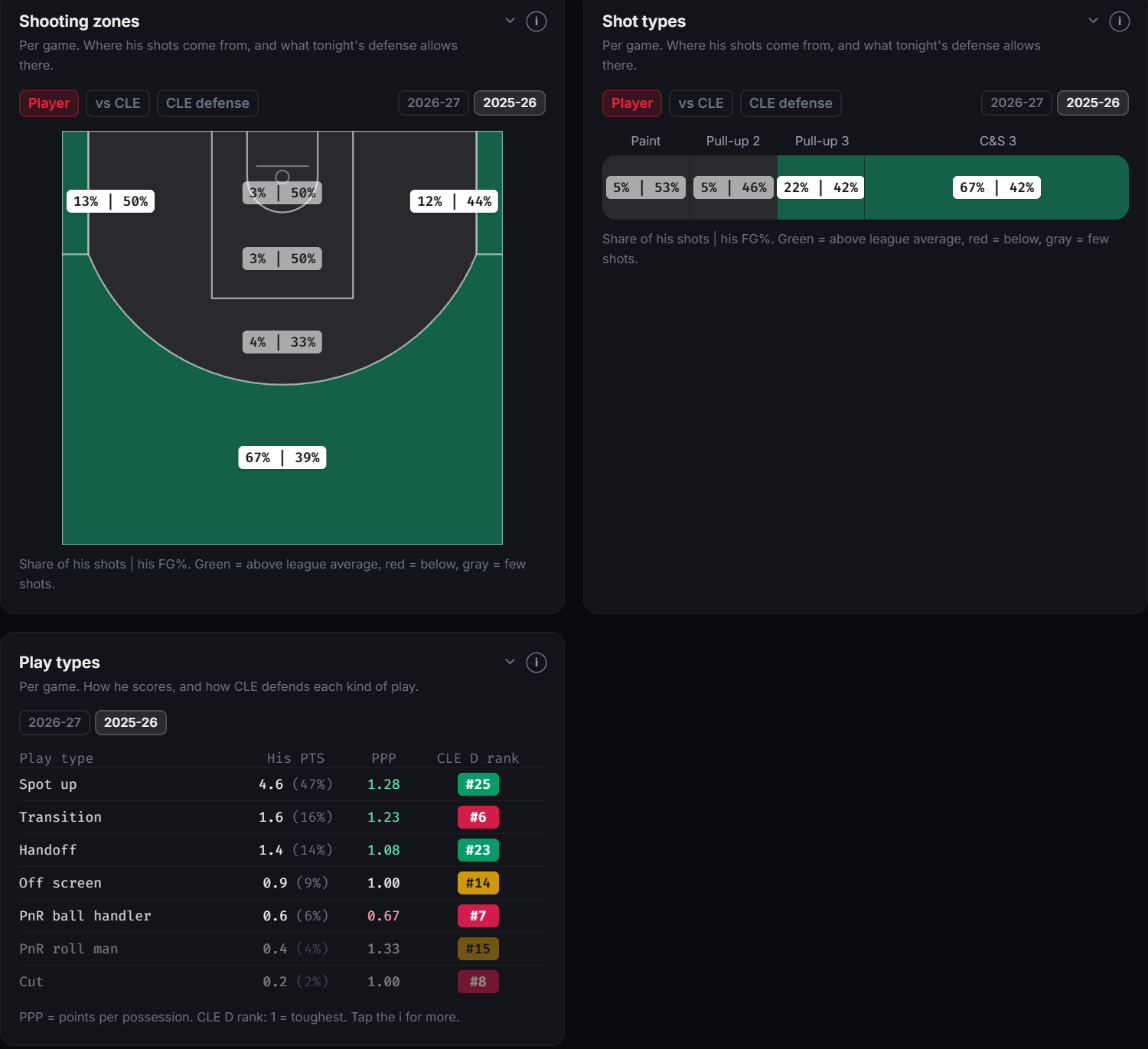
Every player scores in his own way, and every defense is better against some shots than others. The player page has three cards for this.
Shot zones show where his shots come from (rim, paint, midrange, corner 3, above-the-break 3) and how this defense does in each zone. Shot types show how he gets them: pull-ups, catch-and-shoot 3s, and paint shots. Play types show what creates his points, like spot-ups, pick-and-roll, and transition, with how this defense ranks against each one.
You are looking for a match. If most of his shots come from one zone or play type and this defense ranks near the bottom against it, that is a real edge. If it is what this defense does best, that is a red flag, even if the overall rankings look soft.
For rebound and assist props, look past the final number. A rebound chance is any rebound he was close enough to grab, and a potential assist is any pass that would have been an assist if the shot went in. They show the opportunity, not just the result.
Check how many of each this defense gives up to his position, then compare with his own numbers in the Splits and tracking card. Lots of chances against a team that allows lots of chances is a good spot, even if his last few totals were low.
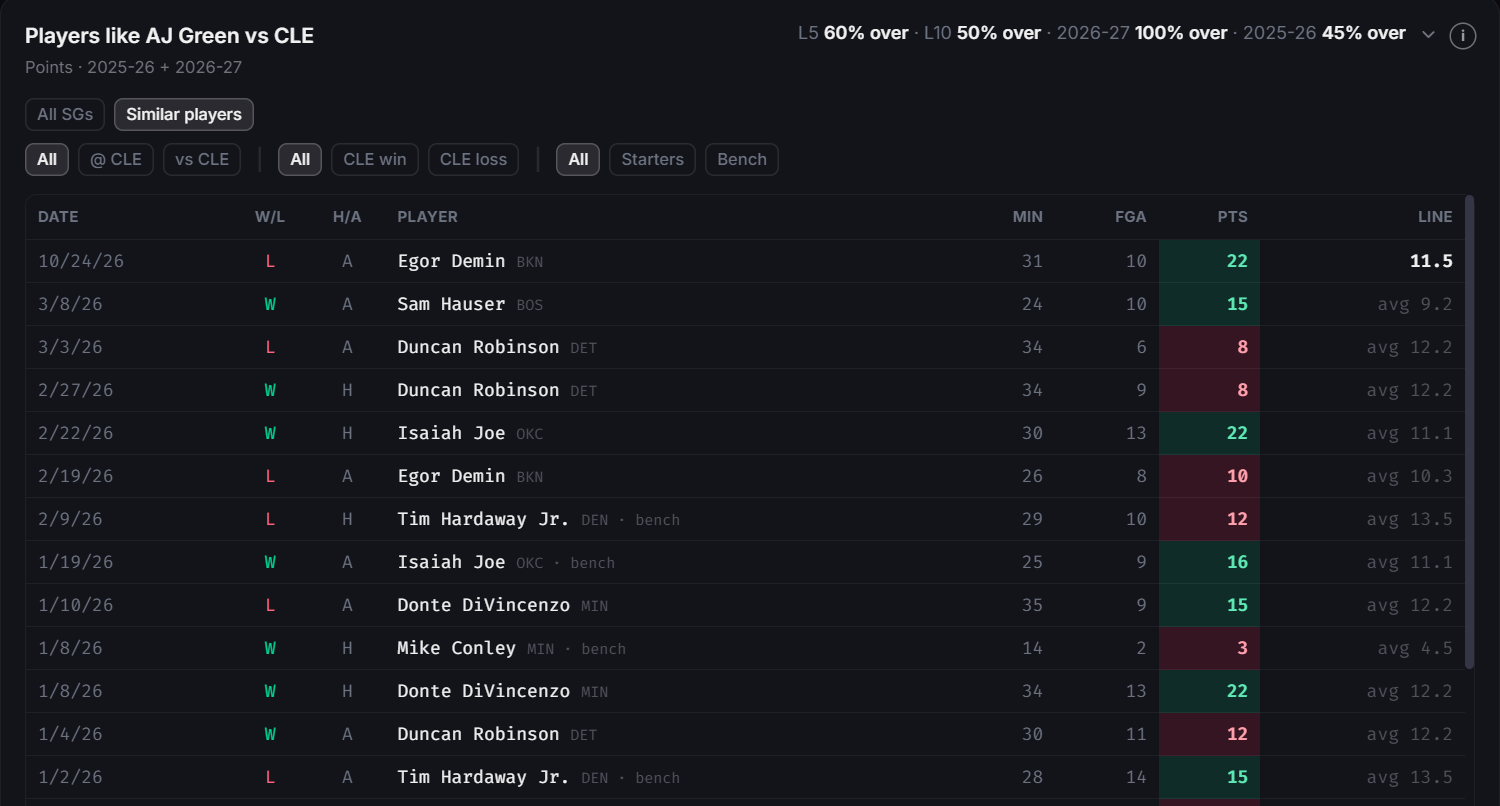
Rankings are averages, so look at the games behind them. On the player page, the position table shows every player at his position who faced this defense, game by game.
Then turn on Similar players. It narrows the table to players who play like him, like other spot-up shooters or ball-handling scorers. If players like him keep going over against this team, that tells you more than a single rank does.
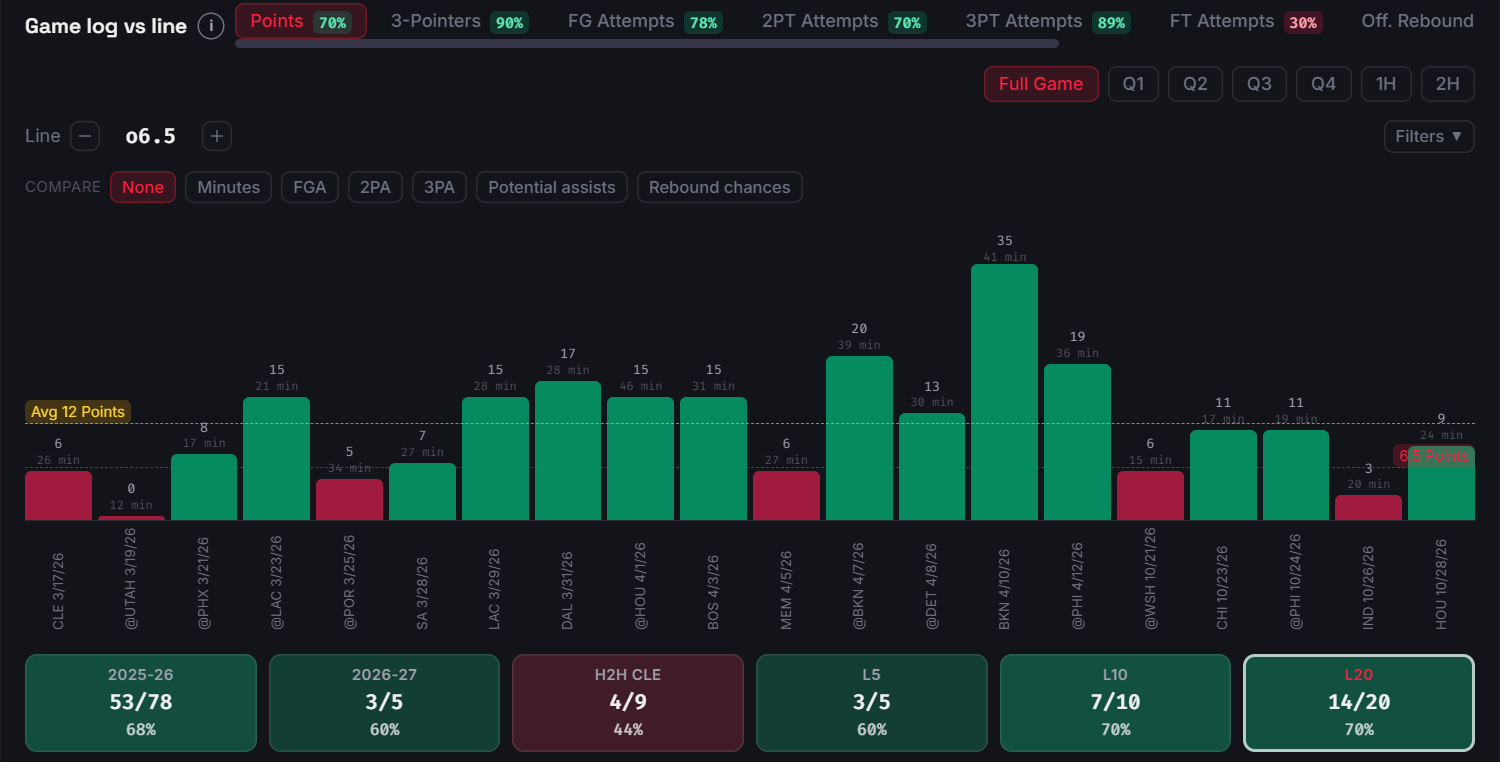
The hit rate is how often the player has cleared this line. Every player page shows it for the last 5, last 10, and last 20 games, by season, and head to head (H2H) against this opponent.
Lean on the last 10 or the full season more than the last 5. Five games is a small sample: one big night or one game cut short by foul trouble can swing it a lot.
H2H is a tiebreaker, not a deciding factor. Teams only meet two to four times a year, rosters change in between, and a player's role can be completely different from one season to the next.
This is the step most bettors skip. Open Filters on the player page and set a volume range. For points, use shot attempts (FGA). For the minimum, use the fewest shots he usually takes. For the maximum, use the most this defense allows to his position, or the most another player has taken against them.
The hit rate now only counts games where he got that kind of volume, which shows you how he performs when his opportunity matches what this matchup is likely to give him.
It works for every prop: 3-point attempts for threes, potential assists for assists, rebound chances for rebounds. For combos like points + rebounds + assists, add every filter that applies.
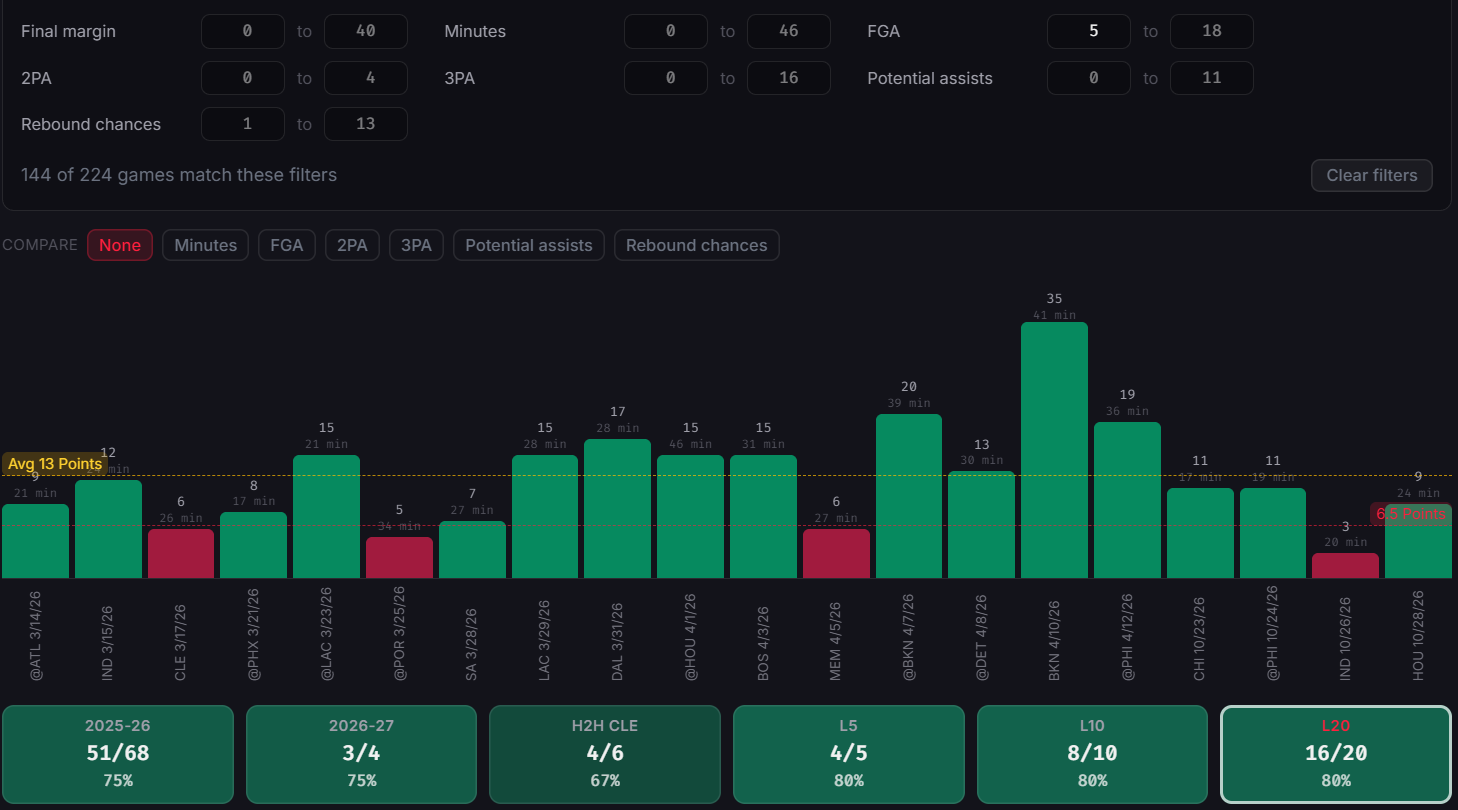
My rule of thumb: if the hit rate is 70% or higher, I take my chance on the over. If it is 40% or lower, I look at the under. Anything in between, I pass, or I only play it if the earlier steps all strongly agree.
One warning: check how many games are behind that number before you trust it. A 70% hit rate over 5 games is really just 4 out of 5 (80%), and one bad game drops it to 60%. Use this rule on the last 10 games, the last 20, or the full season, not the last 5.
Here is the whole process on a real prop: AJ Green over 6.5 points, Cavaliers at Bucks on Saturday, October 31 (numbers as of that afternoon).
The picture: Cleveland is a 9.5-point favorite with a 235.5 total, so the Cavs are implied for about 122.5 points and the Bucks for about 113. A high total means plenty of possessions, which is good for every shooter on the floor.
Blowout risk: 9.5 is close to that 12-point line, but here it helps. Green comes off the bench, so if Cleveland runs away with it, he is one of the players who picks up the starters' fourth-quarter minutes.
Rest and injuries: Milwaukee last played on Wednesday, so no back-to-back. Their whole rotation is healthy, so there is no injury bump in shots, but no one is cutting into his role either.
Defense vs position: Cleveland allows 26.4 points a game to shooting guards (23rd in the league), and more importantly the 5th most shot attempts (21.2) and 7th most 3-point attempts (10.2). They give the position plenty of volume.
How he scores: last season, 67% of his shots were above-the-break 3s, and 67% were catch-and-shoot 3s. Cleveland allows the 6th highest shooting percentage in that zone and ranks 25th against spot-ups, which make up almost half of his points.
Similar players: this one is mixed. Shooters like him went over their own number in 45% of games against Cleveland last season. Egor Demin and Isaiah Joe both dropped 22, but Duncan Robinson fell short four times. Not every step has to agree, and this one is neutral.
Hit rate: this is where it looks shaky. He is 7 for 10 over 6.5 in his last 10, but just 4 for 9 (44%) against Cleveland. He also moved to the bench this season and is playing 15 to 24 minutes a night, so a lot of people would pass here.
Min/max: this is where the picture flips. On a normal night he takes at least 5 shots, and Cleveland gives shooting guards more shots than almost anyone. Set the FGA filter to 5 and up, and his last 10 games in that range go 8 for 10 (80%), and his last 20 go 16 for 20 (80%). Against Cleveland with 5 or more shots, he is 4 for 6. When he gets his shots, he clears this line.
The call: that 80% says over, and the matchup backs it up. The risk is clear too: he is a bench player now, and he only got 3 shots in the season opener. The bet depends on him getting his normal 5-plus attempts. I like the over, but that is the thing to watch.
I lean over at 70% or higher and lean under at 40% or lower, and pass on anything in between. Use the last 10 games, the last 20, or the full season, since 5 games is too small a sample to trust.
A big spread (12 points or more) raises the chance of a blowout. Starters can sit the fourth quarter and lose minutes, which hurts their overs, while bench players often pick up those minutes.
Yes. On the second night of a back-to-back, players often have tired legs, coaches may trim minutes, and some stars sit out completely. Check how a player has done on back-to-backs before betting his over.
A rebound chance is any rebound a player was close enough to grab, and a potential assist is any pass that would have been an assist if the shot went in. They show a player's opportunity, which is often steadier than his final rebound or assist total.
It shows how much a defense allows to each position (PG, SG, SF, PF, C) in points, rebounds, assists, threes, and shot attempts. A defense that gives up a lot to one position is a good spot to look for overs at that position.
A little. Teams only meet two to four times a year, and rosters and roles change in between. Use H2H as a tiebreaker, not as the main reason for a bet.
Founder of Propaholics, builder of the prop model. Picks on Propaholics are graded honestly and tracked every week, so you can judge the model for yourself. See the full model track record.
Propaholics model-driven NFL & NBA prop picks.