New here? Get a 7-day free trial.Full access to every number and matchup. Then $15/mo or $110/yr, cancel anytime.Start free trial →

Before I bet any NFL player prop, I want to answer three questions: how is this game likely to play out, what does this defense give up, and how often does this player actually clear this line?
Here is the step-by-step process I use to answer them, and where to find each piece on Propaholics. At the end, I walk through a real example: Jake Ferguson over 3.5 receptions against the Buccaneers. No single stat makes a pick. The best props are the ones where every step points the same way.
Start by asking how this game is going to go. Will it be pass heavy or run heavy? A shootout or a grind? Every step after this one builds on that answer, so get a rough picture in your head before you look at a single player.
The total (over/under) tells you how many points the books expect. A higher total means more plays, more yards, and more touchdowns to go around. A low total, around 41 or under, means less volume for everyone.
The spread hints at the game script, meaning who is likely to be leading and how each team will play because of it. A big favorite (7 points or more) will often be playing with a lead and running the ball late, which is good for running back carries and bad for receiver volume. A big underdog (7 points or more) will often be playing from behind and throwing, which is good for receiver and tight end targets and quarterback attempts, a lot of it in garbage time. A close spread (under 3) has no strong lean, so trust the matchup.
Bonus tip: work out each team's implied total. Divide the game total by 2, then subtract half the spread for the favorite and add it for the underdog. With a 47.5 total and a team favored by 3.5, that team is implied for about 25.5 points and their opponent for about 22. Now you know which offense the books expect to score more.
Wind is the big one. Strong wind makes deep passes and long field goals harder, so teams lean on the run and short throws. Heavy rain or snow can do the same. That is bad news for passing yards and receiver overs, and can help running back carries.
Domes and closed roofs take weather out of the picture completely. Check the NFL weather page for every game's forecast and roof status before you bet anything outdoors.
Injuries move volume around. If a team's top receiver is out, his targets have to go somewhere, usually to the next receiver up or the tight end. If a starting quarterback is out, the whole passing game takes a hit.
Check two things: is your player healthy (any designation shows on his player page), and is anyone around him missing? On the player page, the with/without teammate filter shows how he has played in games when a specific teammate was out. Also check the other side. A defense missing its top cornerback or linebacker is easier to attack.
Open the free defense vs position rankings and see what this defense allows to the player's position: QB, RB, WR, or TE. A defense ranked near the bottom against wide receivers is a green light to look at receiver overs. A defense that shuts the position down is a reason to slow down.
You can also see this right on the player page. The Opponent defense card shows what this week's opponent allows to that player's specific position, along with where it ranks, so you do not have to look it up separately.

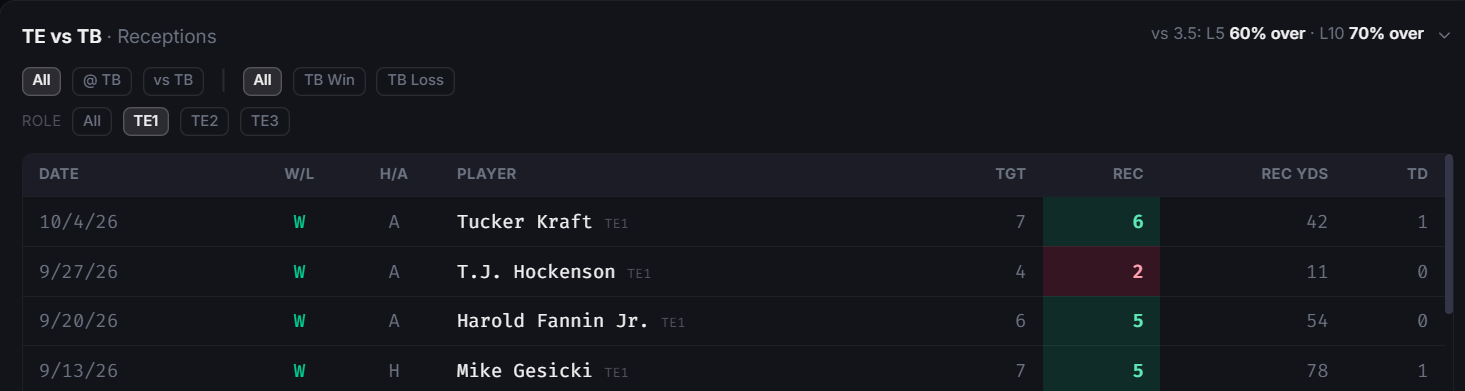
Rankings are averages, so look at the games behind them. On the player page, check what the players at his position did against this defense game by game. If three straight WR1s went over 80 yards against them, that tells you more than a single rank does.
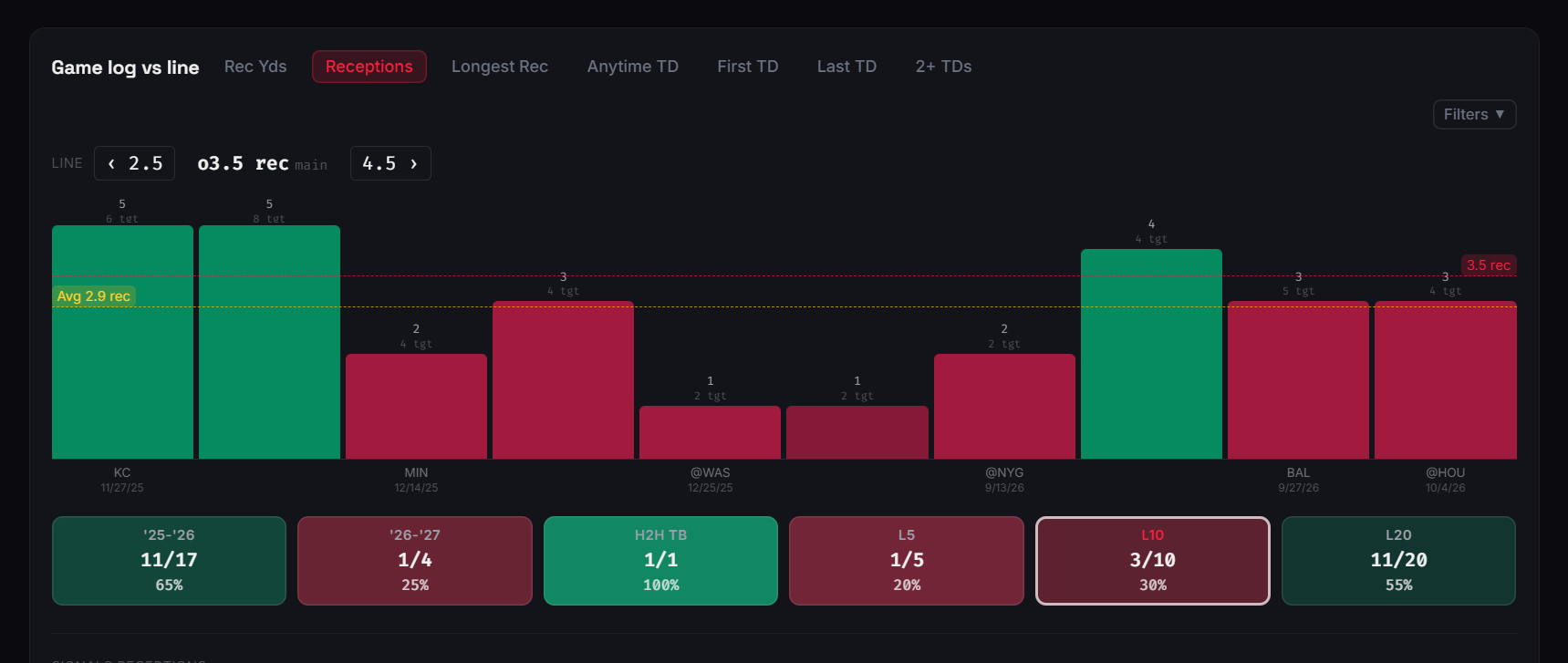
The hit rate is how often the player has cleared this line. Every player page shows it for the last 5, last 10, and last 20 games, by season, and head to head (H2H) against this opponent.
Lean on the last 10 or the full season more than the last 5. Five games is a small sample: one big game or one injury-shortened game can swing it a lot.
H2H is a tiebreaker, not a deciding factor. Players usually only see a non-division opponent once every year or two, so the sample is tiny, and rosters and coaches change in between. A division rival he faces twice a year is more meaningful, but still weigh it less than the current matchup.
This is the step most bettors skip. Open Filters on the player page and set a volume range (targets or carries) based on what you have seen so far. For the minimum, use about what this player usually gets. For the maximum, use the most this defense has given up to the position.
For example, say a receiver averages 6 targets a game, but another receiver got 10 against this defense. Set the targets range to 6 to 10. The hit rate now only counts games where he got that kind of volume, which shows you how he performs when his opportunity matches what this matchup is likely to give him.
My rule of thumb: if the hit rate is 70% or higher, I take my chance on the over. If it is 40% or lower, I look at the under. Anything in between, I pass, or I only play it if the earlier steps all strongly agree.
One warning: check how many games are behind that number before you trust it. A 70% hit rate over 5 games is really just 4 out of 5 (80%), and one bad game drops it to 60%. Use this rule on the last 10 games or the full season, not the last 5.
Here is the whole process on a real prop: Jake Ferguson over 3.5 receptions, Buccaneers at Cowboys on Thursday Night Football (numbers as of Wednesday).
The picture: Dallas is an 8-point favorite with a 47.5 total, so the Cowboys are implied for about 28 points and the Bucs for about 20. The books expect Dallas to score plenty, which is good for their offense. The catch is that a big lead could mean more running late, so this is a mild caution for a pass catcher, not a green light.
Weather and injuries: the game is at AT&T Stadium, which has a roof, so weather is not a factor. Ferguson has no injury designation and Dak Prescott has started every game, so his volume is not in question.
Defense vs position: Tampa Bay allows the 7th most receptions and 6th most yards to tight ends this season, 6.5 catches a game to the position. Looking at the games behind that, all four TE1s they have faced saw 4 to 7 targets, and three of the four cleared 3.5 catches: Mike Gesicki (5 catches), Harold Fannin Jr. (5), and Tucker Kraft (6). Only T.J. Hockenson (2) fell short.
Hit rate: this is where it looks ugly. Ferguson has cleared 3.5 catches in just 3 of his last 10 games and 1 of 4 this season. By the 70/40 rule, that points to the under. The reason is volume: he is averaging 3.8 targets a game this year, down from 6.1 last year. His one game against Tampa Bay was a good one (6 catches on 9 targets in 2024), but one game is just a tiebreaker.
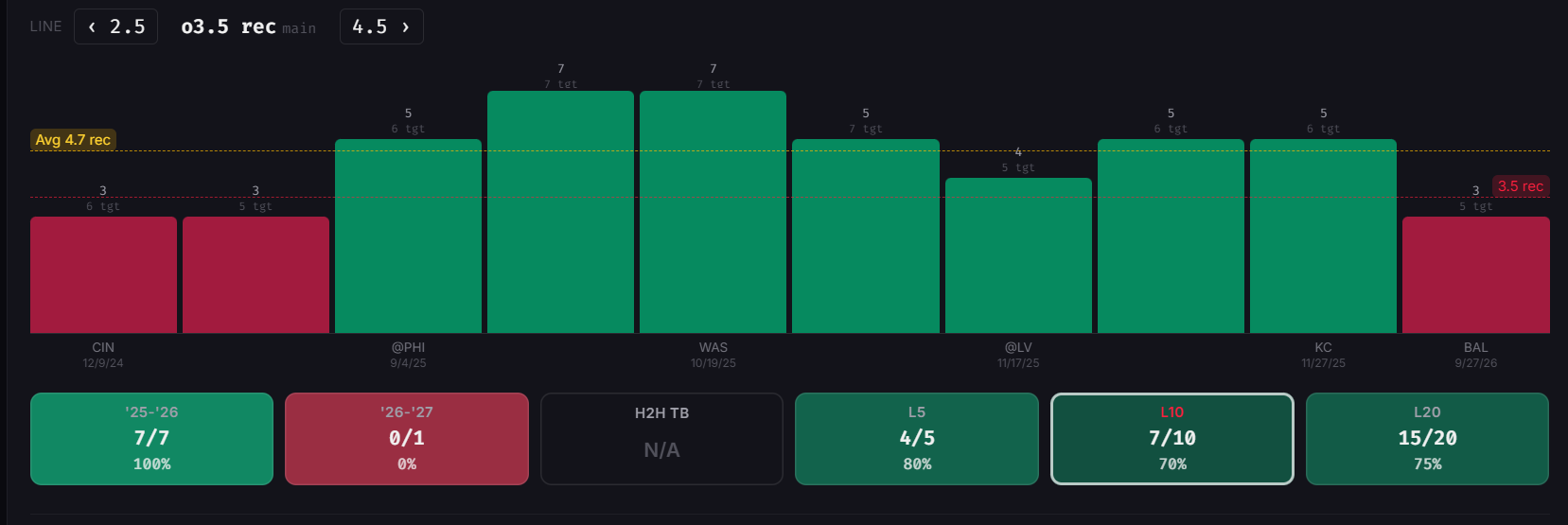
Min/max: this is where the picture flips. He has averaged about 5 targets a game over the last two seasons, and the most a TE1 has seen against Tampa Bay this year is 7. Set the targets filter to 5 to 7 and his last 10 games in that range go 7 for 10 (70%), and his last 20 go 15 for 20 (75%). When he gets normal volume, he clears this line.
The call: that 70% says over, and the matchup backs it up. The risk is clear too: he has only seen 5 or more targets once this season, so the bet depends on Tampa Bay's soft tight end defense getting him back to normal volume. I like the over, but that is the thing to watch. I break this prop down further in my Thursday Night Football props post.
I lean over at 70% or higher and lean under at 40% or lower, and pass on anything in between. Use the last 10 games or the full season, since 5 games is too small a sample to trust.
The spread hints at game script. Big favorites often run more late with a lead, which helps running backs. Big underdogs often throw more while trailing, which helps receivers, tight ends, and quarterback passing props.
Strong wind is the biggest factor. It makes deep passes and long kicks harder, so teams run more and throw shorter, which hurts passing and receiving yards. Games in domes or under closed roofs are not affected.
A little. Players rarely face the same non-division opponent more than once a year, so the sample is tiny and rosters change in between. Use H2H as a tiebreaker, not as the main reason for a bet.
It shows how much a defense allows to each position (QB, RB, WR, TE) in yards, receptions, and touchdowns. A defense that gives up a lot to one position is a good spot to look for overs at that position.
Divide the game total by 2, then subtract half the spread for the favorite and add half the spread for the underdog. A 47.5 total with a 3.5 point favorite works out to about 25.5 for the favorite and 22 for the underdog.
Founder of Propaholics, builder of the prop model. Picks on Propaholics are graded honestly and tracked every week, so you can judge the model for yourself. See the full model track record.
Propaholics model-driven MLB & NFL prop picks.